ARCH_PORTFOLIOv2024–2026
×××

AYDEN

PETTIETTE

INSTITUTION
Texas A&M
DEGREE
B.Arch
PERIOD
2024 — 2026
PROJECTS
04
VIEW_PROJECTS
Ayden Pettiette
×
ARCHITECTURAL_PORTFOLIO ×
Architectural DesignTranslation of Space — Fall 2024×Riverside Residential — Spring 2025Bath House — Fall 2025Mid Rise Complex — Spring 2026×Texas A&M UniversityArchitectural DesignTranslation of Space — Fall 2024×Riverside Residential — Spring 2025Bath House — Fall 2025Mid Rise Complex — Spring 2026×Texas A&M UniversityArchitectural DesignTranslation of Space — Fall 2024×Riverside Residential — Spring 2025Bath House — Fall 2025Mid Rise Complex — Spring 2026×Texas A&M UniversityArchitectural DesignTranslation of Space — Fall 2024×Riverside Residential — Spring 2025Bath House — Fall 2025Mid Rise Complex — Spring 2026×Texas A&M University
Selected Work

PROJECTS

4x projects
2024 — 2026
Spring 2026
04
Mid Rise Complex
Spring 2026Mixed-UseUrban Density

Mid Rise Complex

Residential complex composed of modular units.

LargeDrawings (3) Chunk Model (4) Massing Model (4) Diagrams (2) Site Analysis (2)× Precedents (6)× Art Progression (1)
×
Comprehensive Plan + Bird's Eye View + Axonometric Section3 files
Comprehensive Plan
01
Birdseye View — Colored
02
Section from Drive
03
Chunk Model4 files
Massing Model4 files
Massing — North
Massing — North01/04
Massing — Northwest
Massing — Northwest02/04
Massing — South
Massing — South03/04
Massing — Top
Massing — Top04/04
Diagrams2 files
Massing Movement Diagram
Massing Movement Diagram01/02
Landscape Lines Diagram
Landscape Lines Diagram02/02
× Art Progression1 file
Pattern Study
Pattern Study01/01
Site Analysis2 files
Height Map
Height Map01/02
Noise Diagram
Noise Diagram02/02
× Precedents6 files
Zaha Hadid — 520 W 28th Plan
Zaha Hadid — 520 W 28th Plan · 01/06
Fall 2025
03
Bath House
Fall 2025Public BuildingCivicMateriality

Bath House

Modern day public bath house project.

Showcase Panels (3) Model Pics (4) Chunk Model (4)
×
Showcase Panels3 files
Panel 1
01
Panel 2
02
Panel 3 — Oblique Perspective
03
Model Pics4 files
Physical Model — View 1
Physical Model — View 101/04
Physical Model — View 2
Physical Model — View 202/04
Physical Model — View 3
Physical Model — View 303/04
Physical Model — View 4
Physical Model — View 404/04
Chunk Model4 files
Chunk Model — View 1
Chunk Model — View 101/04
Chunk Model — View 2
Chunk Model — View 202/04
Chunk Model — View 3
Chunk Model — View 303/04
Chunk Model — View 4
Chunk Model — View 404/04
×Spring 2025
02
Riverside Residential
Spring 2025ResidentialLandscape IntegrationSingle Family

Riverside Residential

Riverside single family houses that respond to the environment, site, and neighboring houses.

Section & Graphic (2) Drawings (6) House Model (5) Chunk Model (4) Site Model (3)× Abstract Drawing Progression (6)
×
Section & Graphic2 files
Section 02
01
House Graphic
02
Drawings6 files
Front Elevation
Front Elevation · 01/06
House Model5 files
House Model — View 1
House Model — View 1 · 01/05
Chunk Model4 files
Chunk Model — View 1
Chunk Model — View 101/04
Chunk Model — View 2
Chunk Model — View 202/04
Chunk Model — View 3
Chunk Model — View 303/04
Chunk Model — View 4
Chunk Model — View 404/04
Site Model3 files
Site Model — View 1
Site Model — View 101/03
Site Model — View 2
Site Model — View 202/03
Site Model — View 3
Site Model — View 303/03
× Abstract Drawing Progression6 files
View Capture — Front
View Capture — Front · 01/06

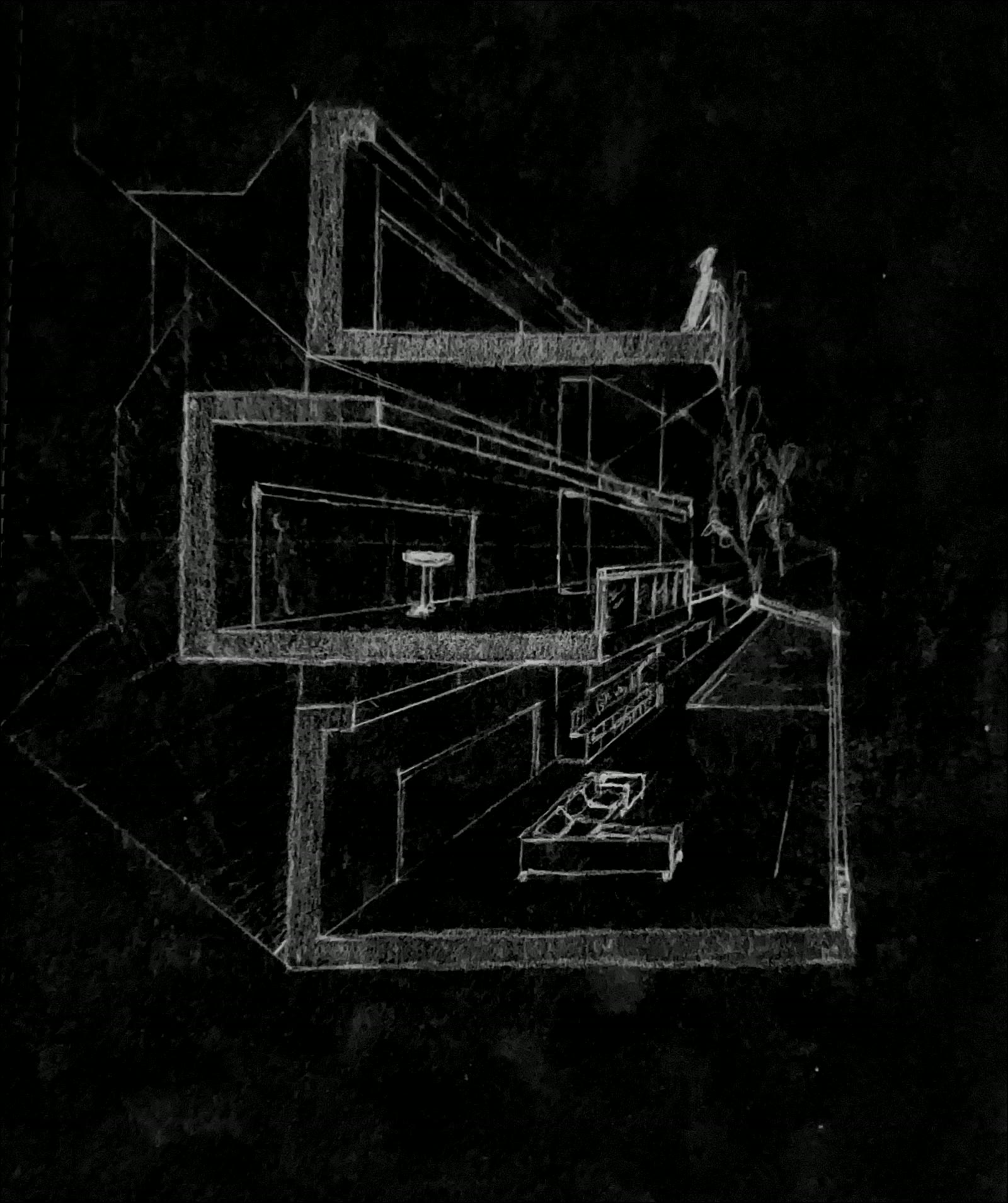
When tasked with developing a building to respond to a set site and environment it is essential to research. Our site in Sunriver, Oregon had many crucial factors to consider before developing a house. The climate, environment, and topography became our focus in our research. The area experiences a low amount of precipitation due to it being located in the rain shadow of surrounding mountains. This caused us to really take into consideration elements like a roof to respond to the climate. The area sits on a high desert plateau and our site has two rivers west of the property. With no budget, these site conditions asked us to think creatively throughout our design process.

To start our design process we began abstract compositions using the defining lines, angles, and shapes of airports across the world. Using trace paper, we could hand draw these compositions and connect shapes and lines based on the defining elements of a satellite view of an airport. These figure and ground drawings were then combined in our group and subject to be manipulated to however each member saw fit. Some saw plan conditions while others represented interesting sections and elevations. To further express what each group member was envisioning, we created three dimensional artifacts and extrusions. These projections started to form spaces of habitation and the formation of a plan view of a building. Inspiration from the group's drawings is present throughout our building. Some pieces are exact shapes extruded as well as inspiration in some of our more monolithic supporting elements. In response to the site being sloped on a riverside, we decided on making our house step down the slope in three layers to create different levels of spaces. The highest spaces serve as social areas and private spaces are found as you maneuver down towards the river.

In contradiction to the downward pull of the floor, the roof is angled to pull space circulation and light up the slope. Our roof design is inspired by the Dancing Light House by Kendle Design Collaborative. However, our roof responds to our site and organizations of social to private spaces in the angles each roof plane is tilted. The roof towards the front is the highest tilted angle up while the lowest step has a less inclined roof. This allows for a better feeling of refuge in the private spaces and allows less cover and more light in the social spaces. The roof is supported by a few columns but mainly monolithic masses. The masses are meant to serve as geological and boulder-like in correlation to the surrounding volcanoes and mountains.

Project title
Fall 2024
01
Translation of Space
Fall 2024Spatial DesignPhenomenologyForm Study

Translation of Space

Development of three spaces maintaining hierarchical order.

Model Views (4) Drawings (6)× Abstract Drawings (4)× Extra Images (3)
×
Model Views4 files
Model View 1
Model View 101/04
Model View 2
Model View 202/04
Model View 3
Model View 303/04
Model View 4
Model View 404/04
Drawings6 files
S&P Prints — Page 1
S&P Prints — Page 1 · 01/06
× Abstract Drawings4 files
Abstract Drawing — 01
Abstract Drawing — 0101/04
Abstract Drawing — 02
Abstract Drawing — 0202/04
Abstract Drawing — 03
Abstract Drawing — 0303/04
Abstract Drawing — 04
Abstract Drawing — 0404/04
× Extra Images3 files
View Capture — Nov 1 A
View Capture — Nov 1 A01/03
View Capture — Nov 1 B
View Capture — Nov 1 B02/03
View Capture — Nov 4
View Capture — Nov 403/03

The project addresses the challenge of forming 3 hierarchical spaces by using a variety of carefully incorporated elements. Through this analysis of these elements, three internal logics are revealed; repetition, difference, and juxtaposition.

Repetition is apparent in the pattern shown in the gaps between the angled geometry. You will notice in the angled geometry a pattern of 8 feet solid, 8 foot gap, 8 feet solid, 4 foot gap, and then 4 feet solid. This pattern's proportions are inspired from my drawing in project 1. However, there is a slight difference in this pattern on the horizontal angled geometry where the last piece is another full 8 feet solid to match the proportions of elements nearby.

Under the same angled geometry, there is a 45 degree, negatively sloped shape that fits between the width of the gap of the above geometry. This shape is a juxtaposition by reversing the order of positive and negative space in the repeating pattern.

The project's primary mass was generated through a series of drawings and grids containing vertical, horizontal, and 45 degree lines. The organizing lines of the project appear similar to what is seen in the grid-like layout of the Geisel Library by William Pereira. However; in contrast to the Geisel, the angled lines, parallels and intersections are utilized to break up symmetry.

Despite this transgression of symmetry, the project is intentionally proportional in a more abstract, less strict way. The generative drawings utilized lines at 45 degree angles to create spiraling motion and cut through each corner of the drawings maintaining a 1:1 aspect ratio, which is an apparent repeating element in my drawing.

The new proportioning system of my model came from the rearrangement of simplified volumes that make up the massing. The lines that create these main volumes were then used as guiding lines for many elements.

Project title
×
About

ABOUT ME

I am an architectural design student exploring the intersection of spatial theory and built form. My work engages questions of threshold, material honesty, and the social dimensions of architecture — from intimate residential scales to civic programs.

// currently enrolled at Texas A&M University
// Bachelor of Architecture candidate

INSTITUTIONTexas A&M University
PROGRAMBachelor of Architecture
SOFTWARERhino · AutoCAD · Adobe
MEDIADrawing · Model · Render
Contact

GET_IN_TOUCH

// open to internships, collaborations,
// and design conversations.

AP○ □ ש 2026